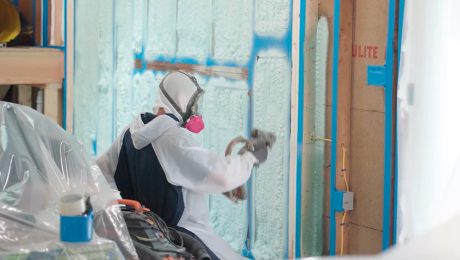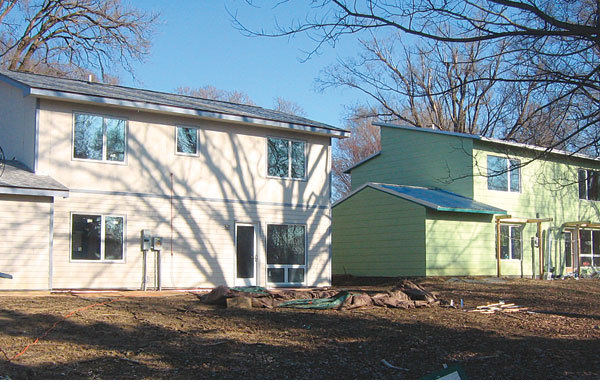
The cold weather in Urbana, lll., barely registered inside the superinsulated houses on display at the second-annual North American Passive House Conference hosted by the Passive House Institute (www.passivehouse.us) and the Ecological Construction Laboratory (www.e-colab.org). The homes incorporate superinsulation details initially developed in Germany and use about 10% of the heating energy of a conventionally built home.
Designed by Katrin Klingenberg of e-co lab, these 1200- to 1300-sq.-ft. houses share a similar construction and design approach: a compact form with a superinsulated envelope, superior airtightness, wholehouse heat-recovery ventilation, and passive-solar gain. The houses also share something even more unusual: They don’t have conventional heating systems. Because superinsulation strategies are employed, the heating requirement is incredibly low. The total peak heating load for each house is about 6600 Btu/hour. Typical homes built to meet the 2006 International Energy Conservation Code would use about 38,000 Btu/hour, or six times as much.
Carbon neutrality within reach today
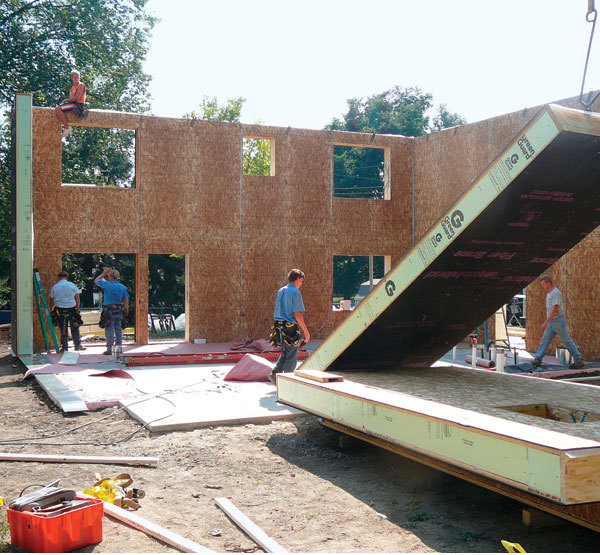
Conference organizers maintain that passive-house construction (residential and commercial, new and retrofit) is economically viable and capable of addressing the energy challenges of today, such as the architecture2030 challenge put forth by architect Ed Mazria (www.architecture2030.org).
Presentations ranged from case studies of passive houses and other ultralow-energy buildings to lectures about building science, metrics, and the philosophy of environmentally responsive design.
Small-group interactive sessions on the second day allowed those present to discuss and debate various issues, such as the current role of architects (help or hindrance?) in low-energy construction. Many attendees were as knowledgeable as the presenters, and conversation flowed from the early morning until late in the evening.
Somewhere along the way, an avant-garde marketing idea for passive houses emerged: “Hot babe heats house.” Technically speaking, though, it would need to be a hot babe with an electric hair dryer.
Photos: Courtesy of Ecological Construction Laboratory