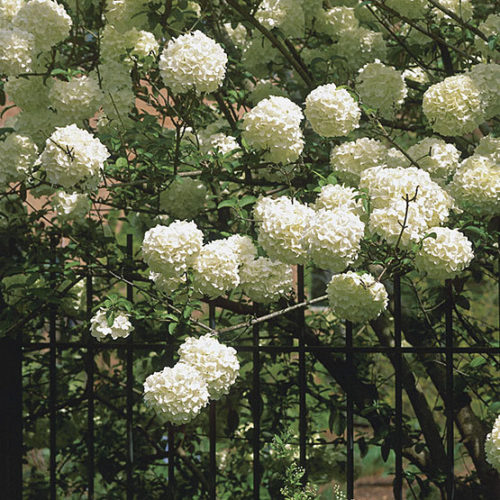
Viburnum macrocephalum (Chinese snowball viburnum)

Viburnum macrocephalum Photo/Illustration: Erica Glasener


Be the first to rate this plant

Hardiness Zones: 1 2 3 4 5 6 7 8 9 10 11
Botanical Name: Viburnum macrocephalum vy-BURN-um mak-roe-SEF-ah-lum Common Name: Chinese snowball viburnum Genus: Viburnum
This semi-evergreen or evergreen shrub has a rounded form. In late spring, it bears flower clusters—sometimes up to 8 inches wide—that start out chartreuse and turn pure white. Dark green leaves are semi-evergreen in southern states, where it can grow to 20 feet high and 15 feet wide.
Care: Provide moist but well-drained soil. Shelter from cold, drying winds.
Propagation: Take greenwood cuttings in summer.
Problems: Viburnum beetle, gray mold (Botrytis), rust, downy mildew, powdery mildew, wood rot, Verticillium wilt, leaf spots, and dieback. Aphids, scale insects, weevils, Japanese beetles, mealybugs, and tree hoppers.
Height 10 ft. to 15 ft.
Spread 10 ft. to 15 ft.
Light Full Sun to Part Shade
Moisture Medium Moisture
Maintenance Low
Characteristics Showy Flowers
Bloom Time Late Spring
Flower Color Green Flower; White Flower
Uses Beds and Borders
Style Woodland Garden
Seasonal Interest Spring Interest
Type Shrubs

Plants you might also like

Viburnum prunifolium Viburnum prunifolium
(Blackhaw Viburnum)
Be the first to rate this plant
Hardiness Zones: 1 2 3 4 5 6 7 8 9 10 11

Blackhaw Viburnum is a large shrub or small tree with clusters of creamy white flowers followed by pink-rose berries, which birds love to eat. Its distinctive bronze-green foliage on reddish purple stems turns blue-black in the fall. Blackhaw grows to 12 to 15 feet high and 8 to12 feet wide.

Cornus drummondii
(Roughleaf dogwood)
Be the first to rate this plant
Hardiness Zones: 1 2 3 4 5 6 7 8 9 10 11

This dogwood can be classified as either a deciduous shrub or small tree. Appealing creamy white flowers appear in late spring and become attractive clusters of milky white fruit in fall. The first cold front often turns the leaves a dark burgundy, and the winter stem tips have a glossy mahogany hue.

Viburnum rhytidophyllum Viburnum rhytidophyllum
(Leatherleaf viburnum)
Be the first to rate this plant
Hardiness Zones: 1 2 3 4 5 6 7 8 9 10 11

This vigorous, coarsely textured evergreen shrub has an upright habit and 8-inch-long, lustrous, deeply veined oval leaves with dark blue-green surfaces and pale green undersides. The leaf stems are fuzzy brown. In spring, fragrant creamy-white flowers bloom in clusters. Blue berries form in June and become plump through September, maturing to glossy black. Plants grow 10-15 feet tall and wide.

Nandina domestica
(Heavenly bamboo)
(1 user review)
Hardiness Zones: 1 2 3 4 5 6 7 8 9 10 11

Yellow-white flowers appear in late spring, followed by prolific berries that ripen from green to bright-red or purple in fall. The elegant foliage turns fiery red in fall. There are low, ground-hugging Nandina varieties; medium-sized shrubs for mid-border; and tall, bushy types for the back of the border.

Tetrapanax papyrifer Tetrapanax papyrifer
(Rice-paper plant)
Be the first to rate this plant
Hardiness Zones: 1 2 3 4 5 6 7 8 9 10 11

Large—to 20 inches across—almost rounded, lobed leaves colored a downy gray-tinged green contrast beautifully with almost any companion plant. This thicket-forming, sparsely branched, evergreen shrub, which behaves like an herbaceous perennial in Zones 6 and 7, produces thick, leafy shoots topped by white flowers borne on branching stems to 20 inches long in fall.