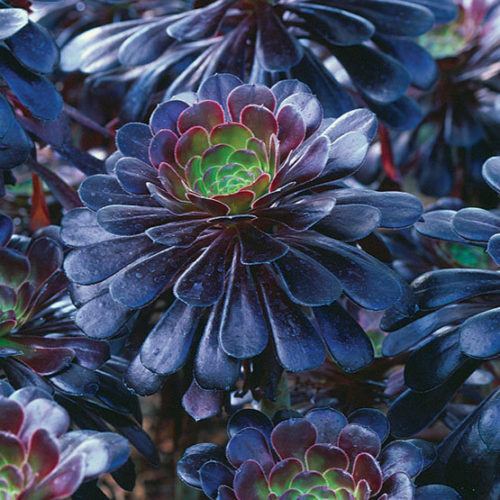
Aeonium arboreum 'Zwartkop' (Black rose)

Aeonium arboreum 'Zwartkop' Photo/Illustration: Bill Johnson


Be the first to rate this plant

Hardiness Zones: 1 2 3 4 5 6 7 8 9 10 11
Botanical Name: Aeonium arboreum 'Zwartkop' ay-OH-nee-um ar-BOR-ee-um Common Name: Black rose Genus: Aeonium
Even those accustomed to the diversity and color of succulents are amazed by the "flowers" of black rose. They are actually burgundy-black leaves arranged in rosettes at the ends of stalklike stems. The bright yellow flowers in winter are a stunning contrast against the dark foliage. 'Zwartkop' is a wonderful backdrop plant, providing a black velvet canvas against which many companion plants shine.
Noteworthy characteristics: This winter blooming succulent has rosettes of blackish leaves that resemble flowers. 
Care: Provide full sun and well-drained soil.
Propagation: Take cuttings in early summer.
Problems: Aphids, mealybugs.
Height 1 ft. to 3 ft.
Spread 1 ft. to 3 ft.
Growth Habit Clumps
Light Full Sun Only
Moisture Dry to Medium
Maintenance Low
Tolerance Drought Tolerant
Characteristics Showy Flowers; Showy Foliage
Bloom Time Winter
Foliage Color Black;Colorful/Burgundy Foliage
Flower Color Yellow Flower
Uses Beds and Borders
Style Rock Garden
Seasonal Interest Winter Interest, Spring Interest, Summer Interest, Fall Interest
Type Cacti and Succulents

Plants you might also like

Dyckia fosteriana 'Cherry Cola' Dyckia fosteriana 'Cherry Cola'
('Cherry Cola' dyckia)
Be the first to rate this plant
Hardiness Zones: 1 2 3 4 5 6 7 8 9 10 11

Dyckias' tolerance of extreme heat makes them perfect for xeriscapes. Almost all are well armored with small but nasty teeth that require careful handling. But many are worth the occasional loss of blood, especially the relatively new cultivar 'Cherry Cola', which features deep, dark burgundy foliage. Bright orange blossoms appear in summer and are a magnet for hummingbirds. Dyckias are unique in being a plantable, in-the-ground bromeliad relative.

Agave parryi Agave parryi
(Mescal)
(1 user review)
Hardiness Zones: 1 2 3 4 5 6 7 8 9 10 11

This plant has a dense rosette of fleshy blue-gray leaves and produces tall, cream-colored flowers tinged with red or pink in summer.

Aloe cameronii Aloe cameronii
(Red aloe)
Be the first to rate this plant
Hardiness Zones: 1 2 3 4 5 6 7 8 9 10 11

There are many beautiful aloes besides the popular medicinal aloe (Aloe vera, Zones 10-11). Most have spectacular winter flowers, and some, like red aloe, have interesting foliage color that fluctuates, depending on water and sun, from green to a deep, red wine hue. Red aloe is easily propagated from cuttings and, over time, will form beautiful red-purple mounds with orange flowers.

Hesperaloe parviflora Hesperaloe parviflora
(Red yucca)
Be the first to rate this plant
Hardiness Zones: 1 2 3 4 5 6 7 8 9 10 11

A clump-forming succulent, red yucca has arching, leathery, linear foliage rising to between 2 and 3 feet tall. Dark olive-green leaves with no thorns or spines are sparsely covered with fibrous strands along the margins. Deep coral pink flowers with golden yellow throats crowd the length of the stalks that reach three feet or more. Foliage has a reddish bronze hue during winter's chill for year-round interest.

Sedum ‘Autumn Joy’ Sedum ‘Autumn Joy’
(Stonecrop)
(11 user reviews)
Hardiness Zones: 1 2 3 4 5 6 7 8 9 10 11

This plant is as dependable and adaptable as they come. Its flowers bloom from August into November; they open pink and mature to a copper befitting of autumn. It is 2 feet tall and wide, with succulent stems and leaves. 'Autumn Joy' looks great with ornamental grasses.